
Blessed Tosin-Oyinbo
●Non-Custodial by Design
How We Made Our AgentPay Protocol Mathematically Unable to Steal Funds
TL;DR
We built a agentic payment protocol where our backend stores encrypted private keys but literally cannot decrypt them. This isn't a policy, it's cryptographic fact. Here's exactly how we did it.
The Problem with "Trust Us"
Basically almost every crypto payment processor says the same thing: "Your keys are safe with us."
But here's the uncomfortable truth: if your payment provider can access your keys, they're a honeypot. A single database breach, a rogue employee, or a government subpoena could expose everything.
At ZendFi, we asked a different question: What if we designed a system where stealing keys was mathematically impossible, even for us?
The Architecture: Client-Side Encryption
Here's how basic traditional payment backends work in a nutshell:
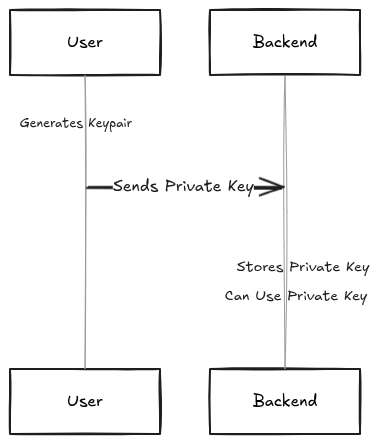
And here's how ZendFi works:
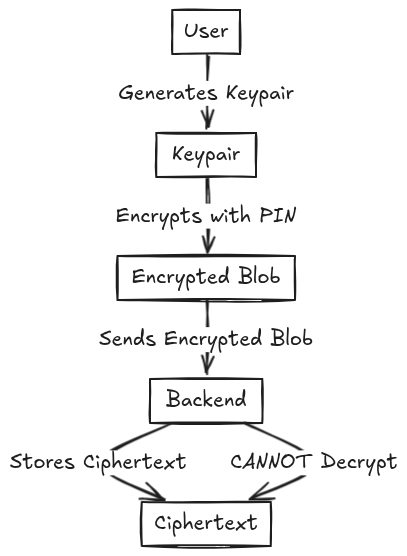
The critical difference: the private key never exists in plaintext outside the user's device.
The Cryptographic Stack
We use a three-layer encryption scheme:
Layer 1: Argon2id Key Derivation
When a user creates a session key, they choose a PIN. We don't hash this PIN with SHA-256 or bcrypt, we use Argon2id, yeah, the winner of the Password Hashing Competition.
Why Argon2id?
- Memory-hard: Argon2id makes it super hard for to use GPUs efficiently
- Time-hard: Each guess takes measurable time
- Side-channel resistant: The "id" variant protects against timing attacks
// Client-side key derivation
const encryptionKey = await argon2id({
    password: userPin,
    salt: deviceSalt,
    parallelism: 1,
    iterations: 3,
    memorySize: 65536,  // 64 MB - makes GPU attacks impractical
    hashLength: 32,     // 256-bit output
    outputType: 'binary'
});
The output is a 256-bit encryption key derived from the PIN + device-specific salt.
Layer 2: AES-256-GCM Encryption
With the derived key, we encrypt the Solana keypair using AES-256-GCM (Galois/Counter Mode):
// Client-side encryption
const nonce = crypto.getRandomValues(new Uint8Array(12));  // 96-bit nonce
const ciphertext = await crypto.subtle.encrypt(
    { name: 'AES-GCM', iv: nonce },
    encryptionKey,
    keypair.secretKey  // 64 bytes: 32-byte private + 32-byte public
);
Why AES-GCM?
- Authenticated encryption: Detects tampering, not just eavesdropping
- Hardware acceleration: Native support in modern browsers via WebCrypto
- Battle-tested: Used by TLS 1.3, Signal, and every major security protocol
Layer 3: Device Binding
The encryption salt includes a device fingerprint, a stable identifier derived from the device's characteristics:
async function getStableDeviceFingerprint() {
    let deviceId = localStorage.getItem('zendfi_device_id');

    if (!deviceId) {
        // Generate once, persist forever
        deviceId = crypto.getRandomValues(new Uint8Array(16))
            .reduce((s, b) => s + b.toString(16).padStart(2, '0'), '');
        localStorage.setItem('zendfi_device_id', deviceId);
    }

    // Hash to fixed-length fingerprint
    const hash = await crypto.subtle.digest('SHA-256',
        new TextEncoder().encode(deviceId));
    return Array.from(new Uint8Array(hash))
        .map(b => b.toString(16).padStart(2, '0')).join('');
}
This means the same PIN on a different device produces a completely different encryption key. Even if an attacker steals the ciphertext AND knows the PIN, they can't decrypt without the original device.
What the Backend Actually Stores
When a user creates a device-bound session key, our database receives:
| Field | Value | Can Backend Use It? |
|---|---|---|
encrypted_key_data | AES-GCM ciphertext | No - needs PIN + device |
nonce | 12-byte random IV | No - useless without key |
public_key | Solana public key | Yes - but it's public anyway |
device_fingerprint | SHA-256 hash | No - can't reverse a hash |
The backend can verify which public key a user controls, but it cannot sign transactions on their behalf.
The "Prove It" Test
Here's a thought experiment. Imagine we're evil and want to steal user funds:
- Attack: Read the database → We get ciphertext. Useless without the key.
- Attack: Brute-force the PIN → 6-digit PIN = 1 million possibilities. With Argon2id at 64MB memory cost, each guess takes ~500ms. That's 5.8 days per key... on a single thread. Parallel attacks hit memory limits.
- Attack: Steal the device fingerprint → It's a hash in our DB. We'd need the original device ID from the user's localStorage.
- Attack: Intercept the PIN → It never leaves the user's device. We literally never see it.
The only way to decrypt is to have:
- The encrypted ciphertext (we have this)
- The nonce (we have this)
- The user's PIN (we never see this)
- The user's device (we don't have this)
We're missing 2 of 4 components. Decryption is practically impossible.
But Wait, How Do Agentic Payments Work?
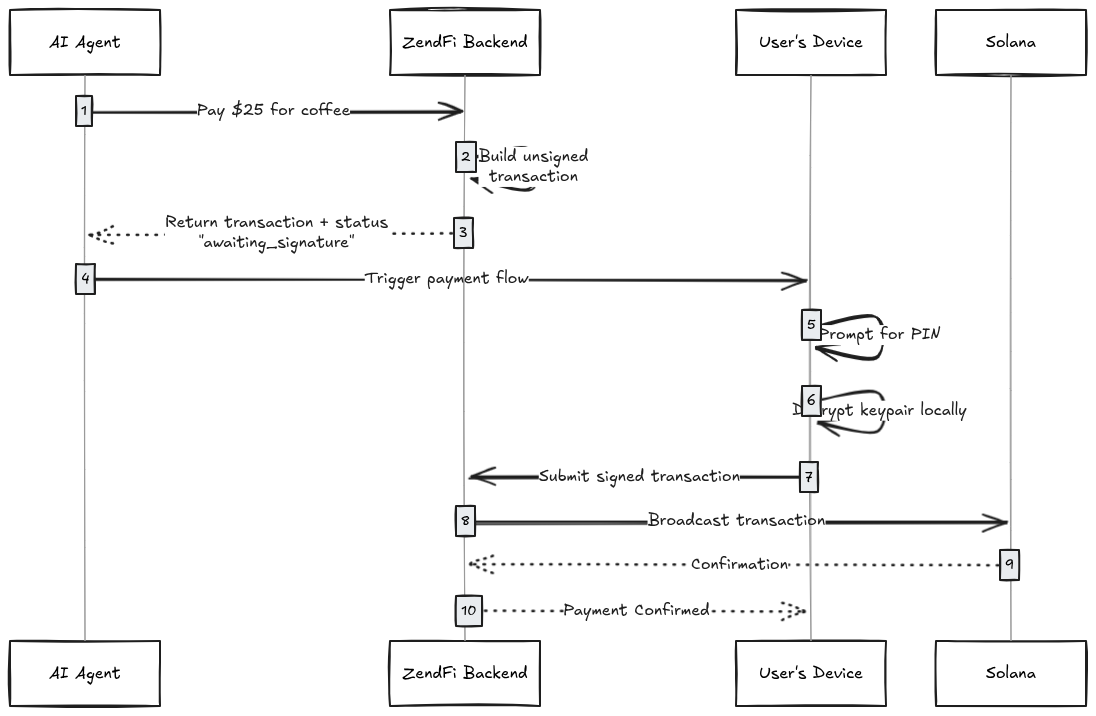
Great question. If we can't decrypt the keys, how does ZendFi enable Agents process payments?
Answer: We don't sign transactions. Users do.
Here's the flow for a device-bound payment:
The signature happens entirely on the user's device. Our backend is just a relay.
The Autonomous Delegate Exception
"But wait," you say, "I've seen ZendFi auto-sign transactions for AI agents. How?"
You're right. For autonomous delegates, we do sign on behalf of users, but with a crucial difference: the keypair is encrypted with Lit Protocol, not just a PIN.
// User opts into autonomous mode by:
// 1. Signing a delegation message with their session key
// 2. Providing a Lit Protocol encrypted copy of the keypair

let lit_encrypted_keypair = encrypt_with_lit(
    keypair_bytes,
    access_conditions  // e.g., "USDC totalSupply > 0" (always true)
);

// Now our backend CAN decrypt... but only via Lit's threshold network
With Lit Protocol:
- Decryption requires consensus from multiple Lit nodes
- No single party (including us) holds the full decryption key
- Access conditions are cryptographically enforced
It's "trust-minimized" rather than "trustless", but the trust is distributed across a decentralized network, not concentrated in our database.
Real-World Security Properties
Let's map our architecture to security guarantees:
| Threat | Traditional Custodian | ZendFi Device-Bound |
|---|---|---|
| Database breach | Keys exposed | Only ciphertext leaked |
| Rogue employee | Can steal funds | Cannot decrypt |
| Government subpoena | Must hand over keys | Can only provide ciphertext |
| Backend compromise | Attacker signs txs | Attacker gets useless data |
| Phishing attack | Attacker steals credentials | Still needs device + PIN |
The Tradeoffs
Nothing is free. Here's what we give up for non-custodial security:
1. No Password Recovery
If a user forgets their PIN, we cannot help them. The encryption key is derived client-side and never transmitted.
Mitigation: We support recovery QR codes that users can back up, but they must do this proactively.
2. Device Lock-In
The device fingerprint is part of the key derivation. Switching devices requires re-encrypting the key.
Mitigation: We support device recovery flows where users can transfer keys using their backup QR.
3. Slightly Slower Payments
Device-bound payments require a round-trip for the user to sign.
Mitigation: Enable autonomous delegates with Lit Protocol for payments under a spending limit.
Why This Matters
In 2022, FTX collapsed and users lost $8 billion because they trusted a custodian.
In 2024, multiple crypto payment processors were hacked, exposing private keys.
The pattern is clear: custody is the vulnerability.
At ZendFi, we didn't build a more secure vault. We eliminated the need for a vault entirely. Our backend is not a trusted party, it's a relay that processes encrypted blobs it cannot read.
That's not marketing. That's math.
Try It Yourself
Want to verify our claims? Here's how:
- Create a device-bound session key at api.zendfi.tech/ai-chat
- Open browser DevTools → Application → Local Storage
- Find
encrypted_session_keyandencryption_nonce - Try to decrypt it without knowing the PIN
Spoiler: you can't. And neither can we.
Further Reading
- Argon2 RFC 9106 - The Argon2 specification
- AES-GCM in WebCrypto - Browser encryption API
- Lit Protocol Documentation - Threshold encryption network
- ZendFi API Docs - Full API reference
Have questions about our security architecture? Reach out at security@zendfi.tech or join our Discord.